Art Marketing
How to use Augmented Reality to sell art online

How do you close the gap between browsing and buying art online? The biggest challenge is that buyers can’t stand in front of the work, feel how it fills a room, or imagine how it will fit with their decor. The answer is that you need to start using Augmented Reality to sell art online, because it lets collectors experience your work in their space. Anywhere, anytime, at the right scale.
For artists, gallerists, art advisors, and art dealers, that means less hesitation and more conversions. For buyers, it turns a guessing game into a confident decision. This guide covers what makes a great AR tool, how ArtPlacer leads the category, and how to put it to work across your entire sales strategy.
Contents
Does Augmented Reality help sell art online?
Imagine you’re a collector considering a painting for your living room. You love the piece, but you’re not sure how it will look in your space. Will the colors match your decor? Is it the right size for the wall?
AR solves these questions by letting buyers preview art in their own environment, at scale, before purchasing. It bridges the gap between screen and real life, so buyers can experience the art in context before they commit. And art professionals who incorporate AR into their businesses see increased engagement, more retention, and ultimately, more sales.
That means the technology works, but only if the tool behind it is built for the job. That’s why ArtPlacer is the leading augmented reality platform for artists and galleries: it offers the most complete set of AR tools purpose-built for selling art online. Here’s what separates a tool built for art professionals from one built for everything else.
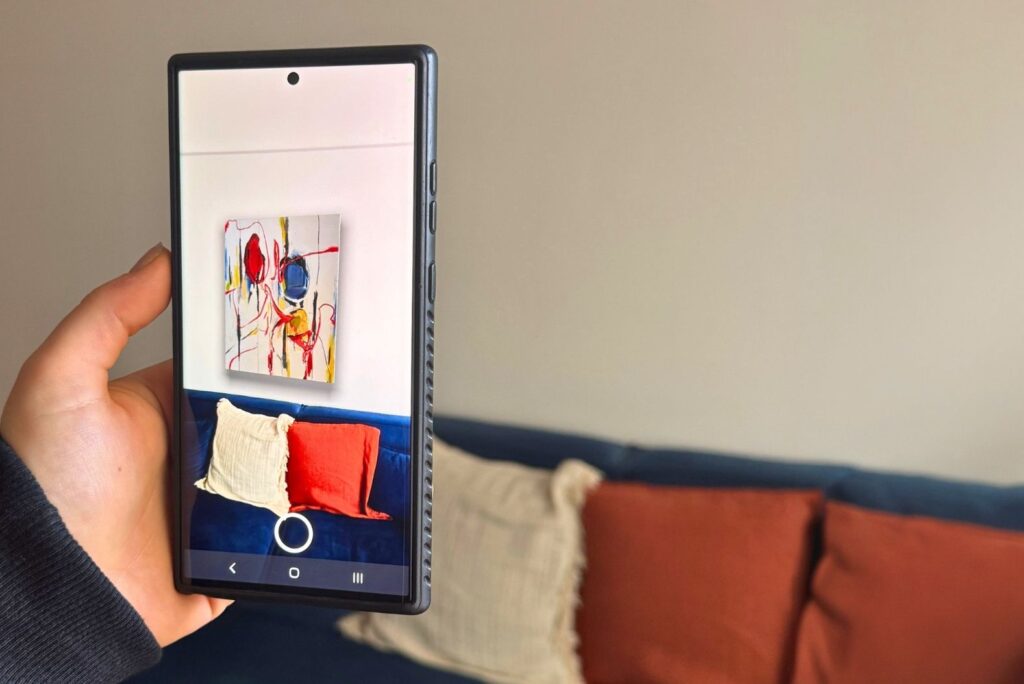
Using AR, collectors can see exactly how a piece would look in their real-life space.
What are the best Augmented Reality tools for previewing art on walls?
Not all AR tools are built for art, and not all art AR tools are built for selling. When evaluating your options, there are five qualities that separate genuinely useful tools from novelty features.
1. True-to-scale rendering: Every artwork should be displayed at scale, so collectors get an accurate sense of size and presence. That accuracy is what creates buyer confidence and turns a “maybe” into an enthusiastic “yes”.
2. Ease of use: It should also be simple to access and use, because a tool that requires a lot of setup, app downloads, or multi-step instructions loses the buyer before they’ve started.
3. Flexible integrations: You should be able to incorporate Augmented Reality into your website or artwork product page without a developer or technical expertise.
4. Artwork upload and management: You should be able to upload your own works in standard formats, enter real dimensions, and manage your catalog without friction.
5. Robust business features: Whatever AR tool you choose, it should connect to your overall business strategy. Look for those that provide data capture and analytics.
6. Built for art professionals: Don’t go for general-purpose AR tools; choose one that’s built with artists and gallerists in mind. Scaling, artwork upload, analytics, and collector-facing presentation need to be designed around the way art actually gets discovered, experienced, and sold.
This is how art gallery Pared uses ArtPlacer’s Augmented Reality tools to provide a try-before-you-buy experience for collectors that helps eliminate doubt around size and fit of a piece.
Using Augmented Reality to sell more art online
If you’re planning to use AR to sell more art, you have to make it easy for collectors to find it and try it: on your website, inside a Virtual Exhibition, or through your own dedicated mobile app. ArtPlacer builds AR into all three, so every touchpoint in your sales process becomes an opportunity for a collector to experience your work in their own space. Here’s how each one works.
How to use Augmented Reality without coding
The easiest and simplest way to incorporate AR into your sales process is by embedding it where buyers already find your work: your website.
ArtPlacer’s AR Widget lets you add a “View in AR” button to any artwork listing with no developer required. A collector browsing your site taps the button, points their phone at a wall, and the piece appears in their space at perfect scale. They can find the piece they love and buy it with no hesitation.
Setup takes minutes. From there, every piece in your catalog can become an immersive preview experience, ready to deploy wherever you sell: your portfolio site, your Shopify store, or your Squarespace page.
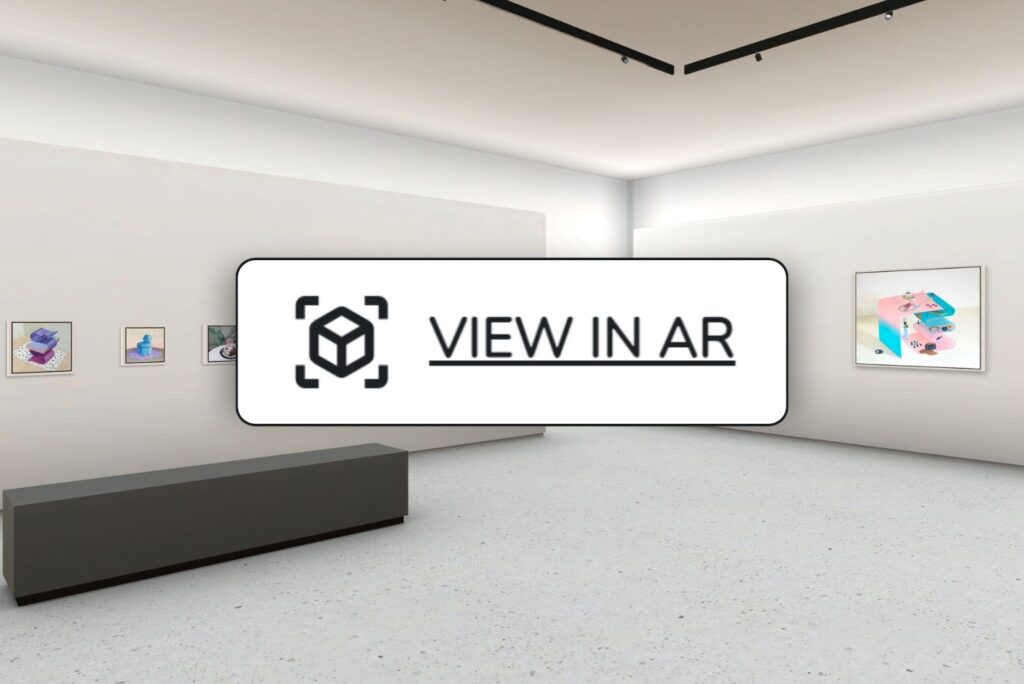
A screenshot of an ArtPlacer Virtual Exhibition with a superimposed screenshot of the “View in AR” button. Users can enable AR inside Virtual Exhibitions so collectors can try the art in their own spaces.
Can you use AR inside a Virtual Exhibition?
Virtual Exhibitions are already one of the most effective ways to present work online, because they give collectors a curated, gallery-like experience from wherever they are in the world. AR makes that experience significantly more powerful as a sales tool.
ArtPlacer’s Virtual Exhibitions support the AR Widget natively, so visitors exploring it don’t just browse; they can place any piece on their own wall without ever leaving the show. This turns passive viewing into an active, immersive decision-making process. A collector who places your work on their wall is imagining owning it. Combined with ArtPlacer’s exhibition analytics, you can see exactly which works drove the most AR interactions, giving you data to inform follow-up outreach and future show curation.
Can you sell art through your own mobile app?
For galleries ready to offer a dedicated collector experience, ArtPlacer can help build your own custom mobile app, a fully branded environment that puts your work straight into your collectors’ pockets.
AR is built into the core of the experience. Collectors browsing your app can tap “View in AR” on any piece and immediately see it on their wall at true scale, with no browser redirect and no loss of context. The entire journey (from discovery to try out and inquiry) happens inside your branded space. The app also supports saved favorites, direct messaging, and CRM integration, so every interaction becomes a trackable touchpoint you can follow up on.
ArtGal.Online, a gallery dedicated to contemporary African art, is a stellar example of what this can look like. Their custom app, powered by ArtPlacer, lets collectors explore original paintings, sculptures, and mixed-media works from stand-out African artists, and place any piece directly in their space using AR. Providing a try-before-you-buy experience eases decision-making and builds confidence in the relationship, encouraging future sales.
Artgal’s app is a seamless experience that brings a lovingly curated collection into collectors’ homes everywhere in the world. Getting there only takes a chat, and we’d love to talk about what a custom app could look like for your gallery. Let’s meet!
ArtGal.Online worked with ArtPlacer to develop their own app and provide a fully branded experience for their collectors.
How do you start using Augmented Reality to sell art online?
Uncertainty is the biggest obstacle in online art sales, and Augmented Reality can help you remove it. ArtPlacer gives you the tools to make that happen, in one platform built specifically for art professionals. Where other tools offer AR as a feature, ArtPlacer offers it as an ecosystem: a set of connected tools that work together across your website, exhibitions, and mobile presence.
Ready to boost your online art sales with the power of AR? Start your free ArtPlacer trial today and bring your art to life for collectors everywhere.


Your platform sounds very interesting and could be quite useful for my artistry business purposes.
Hi David, we’re so glad to hear that! You can sign up here https://www.artplacer.com/signup/, we’d love to have you be part of ArtPlacer. Kind regards, Martin