Art Marketing
The ultimate artist website checklist: must-dos, must-haves, and essentials

Strong artist websites have five core pages: home, about, contact, blog, and shop. They also follow simple design rules, work well on mobile, and make buying art easy.
Your artist, gallery, or art business website is your window to the world. It’s where you show who you are and what you do. In addition, it opens the door to art sales, collaborations, press, and reviews. However, a site needs certain features to stay readable, attractive, and findable among thousands of art websites.
So, what makes a good art website? Keep reading for our dos and don’ts
Download for free “The ultimate artist’s website checklist” to review your own site and update it.
Key takeaways
- Plan your five core pages before you choose a design: home, about, contact, blog, and shop.
- Keep the design simple, with two fonts, one color palette, light images, and a mobile-friendly layout.
- Use your homepage to guide visitors with a clear menu, a main banner, and calls to action.
- Make buying easy with detailed artwork pages, Room Mockups, and a “See it on your wall” button.

It’s a good idea to research artist websites in your field to see what works before you start putting your own together.
What pages should artist websites have?
Maybe you’re updating a professional artist website, an art business page, or an art print e-commerce store. Or perhaps you’re starting from scratch. Either way, your first step is to define the site’s main structure.
When it comes to creating an attractive and readable website, simplicity equals success. First, list the main things your website should communicate. For example, visitors will want essential information about you and your art experience. You’ll also need an artwork showcase, a contact option, and a way to buy one of your pieces. Each of these goals becomes a main page. Then, each page gets a spot on your main menu and your homepage.
Knowing your main pages from the start helps you design a site with clear navigation. So, which pages should every artist website have? Check this list:
- Home page: this is the first page visitors see, so it should introduce them to your website.
- About page: this is where artists present themselves and what they do. Similarly, galleries and art print businesses use it to present their work and brand.
- Contact page: this simple page shares general contact details for potential clients, fans, and subscribers. Remember to also add your email and links to your social media profiles.
- Blog: articles and different types of short and long reads are essential for SEO (search engine optimization). They also help you develop the storytelling around you, your brand, and your art business.
- Art shop or e-commerce section: this space covers the commercial side of your art business. Here, visitors can view your pieces, ask about them, or enjoy a seamless art purchasing process.
If you only want to show your work, a simpler art portfolio website may be enough. However, if you plan to sell, add a shop section from day one.
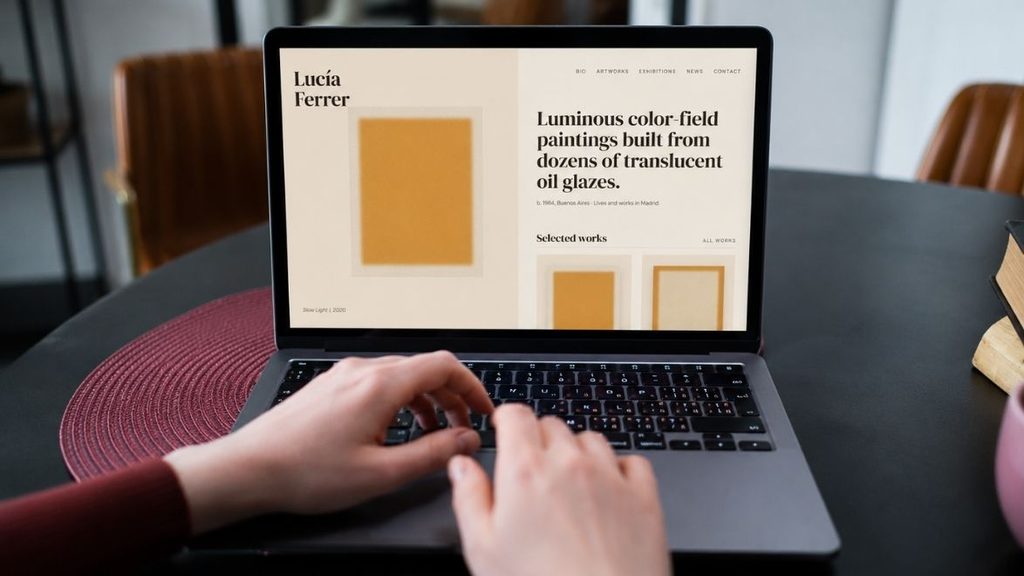
A good example of art website design: two typefaces, a warm, limited palette, and a simple top menu.
What are the dos and don’ts of art website design?
You’ve now reached the point where you choose a design. You might create an original one, work with a designer, or pick a matching theme or template. Before you decide, though, take these general rules into account. As a result, your artist website will stay readable and attractive to visitors. These rules apply to art gallery website design, too.
- Don’t use more than two typefaces: one for titles and one for body text.
- For body text, use a font size of at least 14 for easy reading.
- To make links stand out, keep all descriptive and supporting text in the same style, color, and font.
- Choose a color palette that represents your body of work, and then stick with it.
- Avoid harsh, high-contrast color schemes, like bright text over a black background.
- Make sure your theme or design is mobile-friendly, because most visitors will browse from their phones.
- Yes, we want to see your art! However, avoid cluttering your pages with too many images.
- Compress or resize your images to avoid long loading times. As a rule, keep each image file between 100 KB and 250 KB.
- Make sure your branding comes through across the whole website.
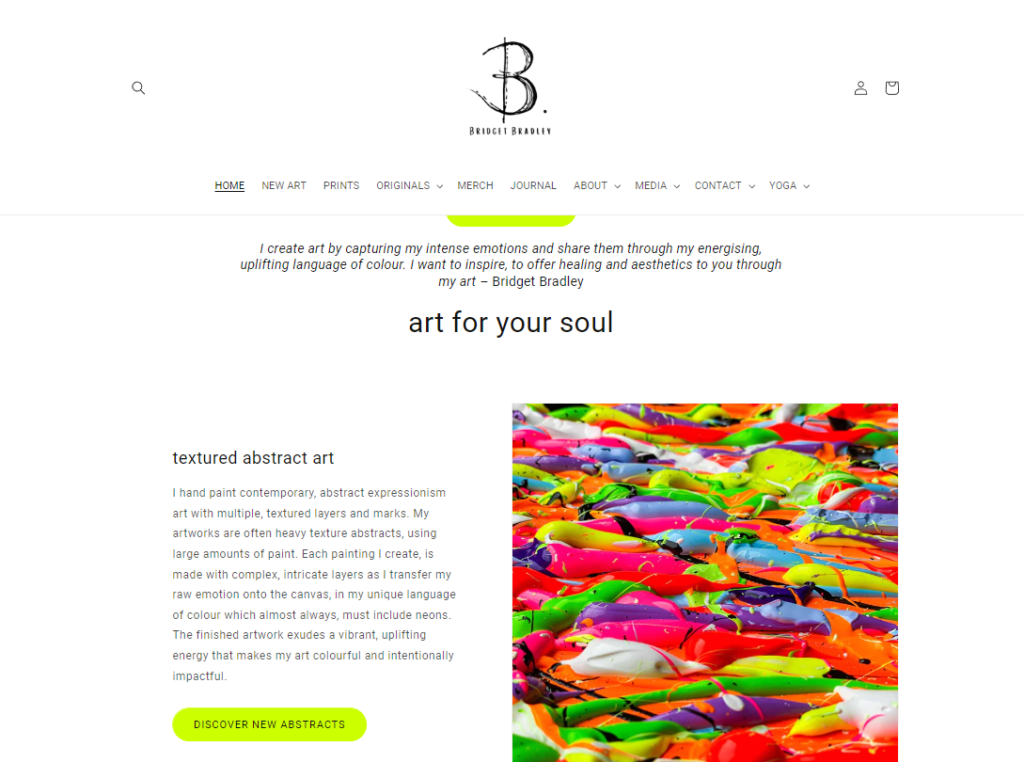
Artist Bridget Bradley created an easy-to-follow menu and structure facilitating navigation on her homepage and making her content and art more reachable.
What should an art website homepage include?
It’s time to get into creative mode and make your homepage a reality. Think about it: this is a visitor’s first impression of you. That’s why it should be easy to understand. It should represent who you are and the type of art you make. Finally, it should share any big events or important news you want to announce.
How can you achieve this? Follow this structure to build your homepage:
- Top menu: add a top navigation bar, so users can easily find every section of your website.
- Search bar: make it easy for visitors to find the exact content they want to see.
- Main banner: are you promoting a new virtual exhibition? Or maybe your next collection or an upcoming show? Use this space to highlight what you want visitors to see first.
- Highlighted sections: give each main page its own section on the homepage. Then, add a call to action that links back to that page for a seamless experience.
- Call to action (CTA): each section, block, or banner needs a clear call to action. For example, you could write “Visit the online show” or “Join the newsletter”.
- Newsletter opt-in: building a mailing list is a great asset for any artist or art business. So, if you want to grow your audience, add a banner, pop-up, or form to join your newsletter. You can use the “Subscriber form” from ArtPlacer for this purpose.
- Footer: close your homepage with clear text links to your main pages and your copyright information. You should also add terms and conditions for shipping and any other services you offer.
- Social media links: list all your social media profiles in your footer. Ideally, use each platform’s recognizable logo, so people can easily follow you there. Also, include a link to your email.
How can your homepage help you grow your contact list?
Turn a Virtual Exhibition into a lead magnet and host it on your main page. With ArtPlacer’s lead-generating feature, you can ask visitors to provide their name and email to access your online art show. This is an easy way to grow your contact list. You can manage all new leads from the “Contact” tab on your profile.
Begin generating leads and connecting with potential collectors: start your ArtPlacer free trial today.
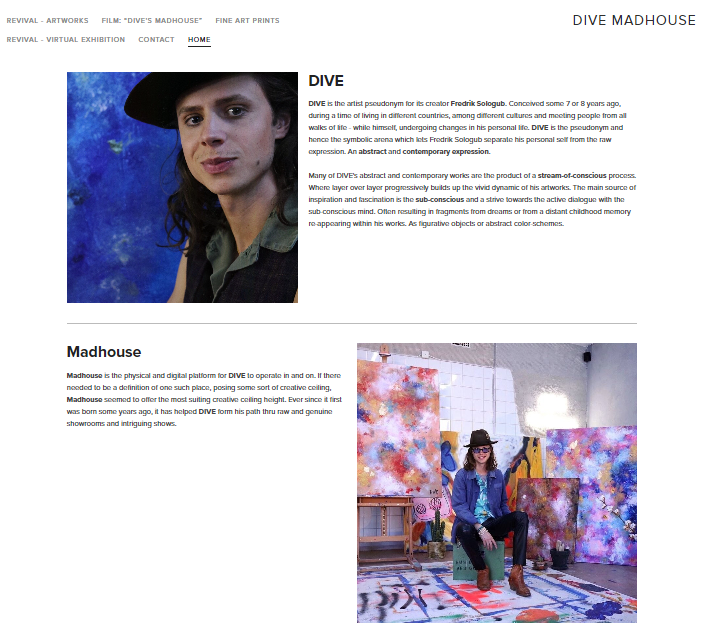
Artist Dive MadHouse engages visitors and potential collectors with strong storytelling around his persona, artworks, and creative process.
What should an artist’s “About me” page say?
Let’s talk about you. The “About me” or “About us” page of any art or art business website is the space where you get to tell your story: where you come from, what you expect to achieve, what inspires you. Remember that people develop empathy with your work and with you; this is the place where you let them know who you are and let that relationship flourish.
So, what should an “About me” page say?
- It should include a short bio of the artist, art collective, gallery, or art print business.
- Include a photo of the artist or team. Better yet, go the extra mile and share a picture of your studio.
- Give readers a break by placing some of your most important artworks between blocks of text. This is a great place to use Room Mockups of your art.
- Add a section for your resume. Highlight prizes, residencies, and other key career milestones. Ideally, also offer it as a downloadable PDF file.
- You can also add your artist statement to help readers understand how you think about your work and what you hope to communicate.
- Make sure to add a “Press” section with all mentions of your work in digital or print media. For example, include art show reviews and interviews.
- Add a clear CTA that tells people how to contact you.
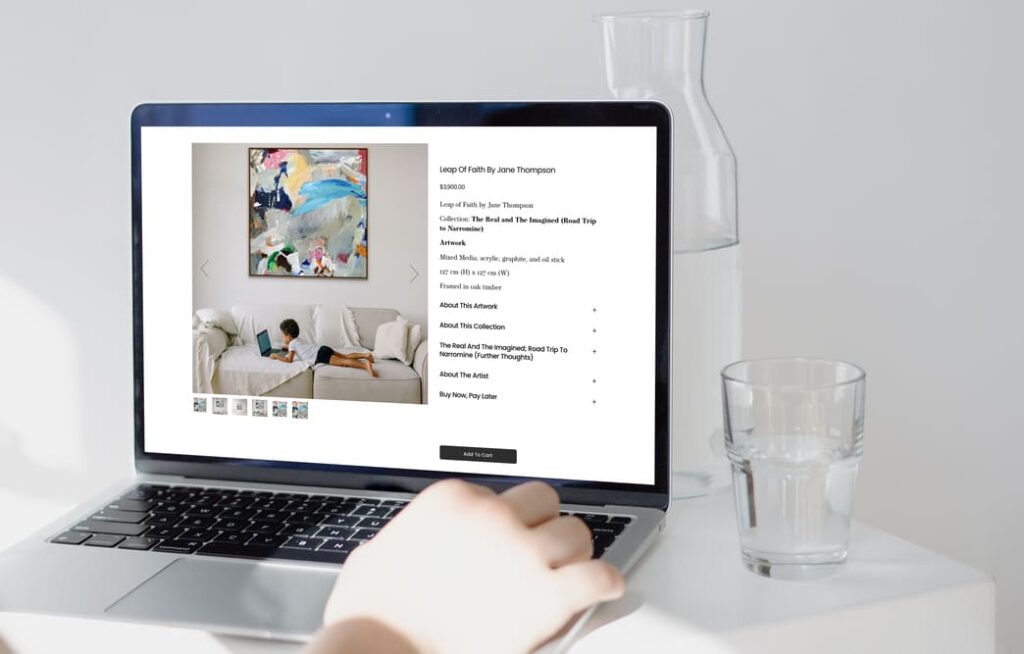
SIBU Gallery has enriched its artwork descriptions with room mockups of the currently available pieces.
How can you sell art from your website?
“How to sell art online?” is a question on most creators’ minds. All you need is a strong website with an e-commerce section. There, potential collectors can browse your pieces and buy them. This is also what sets the best websites for artists to sell work apart.
So, how should the e-commerce section of an art website look?
- Each artwork needs its own page with a full description, including themes, subjects, and medium. Also, AI technology can be a great ally in creating SEO-enhanced texts.
- Clearly display the size of each piece. Similarly, list framing and matting options if you offer them.
- Highlight your shipping options when they’re available.
- Add a clear, visible “Buy” button for a seamless purchase.
- Offer a “try-before-you-buy” experience with ArtPlacer’s Widgets. For instance, a “See it on your wall” button lets collectors preview a piece with augmented reality technology.
- Make sure you have professional-quality photos of each artwork. Then, help buyers picture the piece in a living room or office with Room Mockups.
- If you sell art prints online, create a wall art mockup of your artwork in each available size. As a rule, offer at least three sizes: small, medium, and large. For a step-by-step guide, check this exclusive ArtPlacer Academy lesson. In it, photographer Chase Teron shares how to create Room Mockups of art prints in bulk.
- Add social sharing buttons. That way, visitors can share their art finds on their own profiles. As a result, you build social proof around the impact of your work.
How can an online art show boost your sales?
An online art show is a great way to drive direct traffic to your website. It also takes visitors on a journey that leads to art purchases. With ArtPlacer’s Virtual Exhibitions, you can host your own show with seamless purchase options built in. Then, pair it with a killer art marketing promotion strategy to capture potential collectors’ attention.
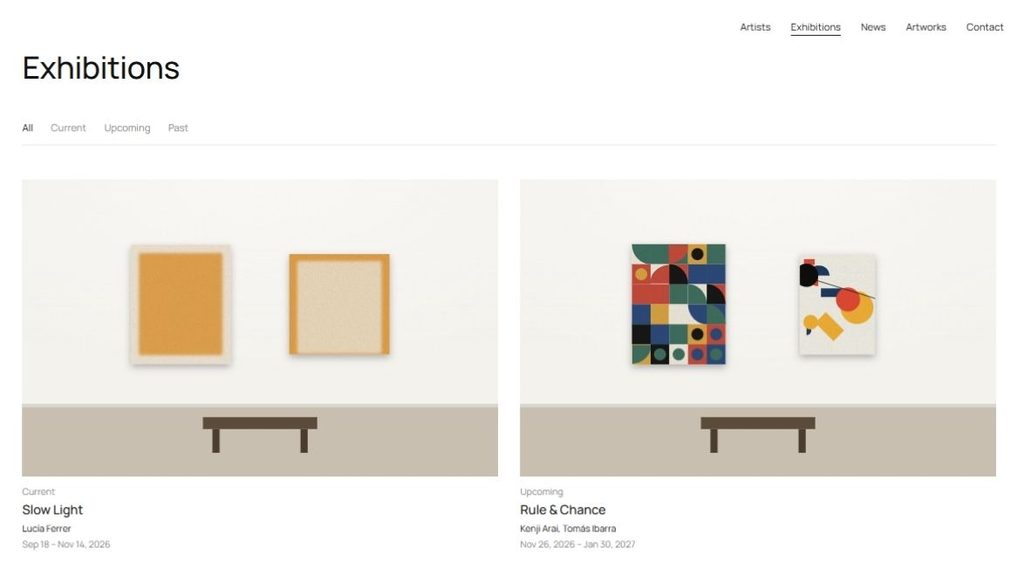
The best art gallery website examples use Virtual Exhibitions to grow their mailing list. Just ask visitors to share their email to enter a virtual show.
What if I can’t build an artist website?
When you’re selling your art, a website isn’t really optional. It’s your professional home, and the first place a collector looks to learn more about you. So, if you don’t have a site yet or want to improve yours, the ArtPlacer team can help.
You’ll get a website where visitors can really understand your practice, your story, and the work itself. As a result, they’ll leave feeling like they know you. We’ll also integrate ArtPlacer’s features so your work is always shown at its best and your website is fun and easy to navigate. Interested? Send us a DM on Instagram to get started.
Now you know the basics of a good art website. So, grab your checklist, review your own site, and make the upgrades it needs to succeed.
Get the marketing tools for artists you need today. Log in to your ArtPlacer account or start your free trial today.
FAQ
Most artists need five core pages: home, about, contact, blog, and shop. If you only want to show your work, a three- or four-page artist portfolio website can be enough. However, if you’d rather not build those pages yourself, ArtPlacer’s team can create your site for you. Just send us a DM on Instagram to get started.
A good design keeps things simple, with two fonts, one color palette, and a mobile-friendly layout. It also uses consistent, uncluttered images that load fast. ArtPlacer’s Room Mockups help here, because they show every piece in a clean, realistic setting. As a result, your whole site looks cohesive and professional.
Add a newsletter sign-up form to your homepage, and give visitors a reason to join. For example, an online show or virtual art gallery works well as a lead magnet. With ArtPlacer’s Virtual Exhibitions, visitors share their name and email to enter the show. Then, you can manage every new lead with ArtPlacer’s Contact Management tools.
The easiest way is to add a “See it on your wall” button to each artwork page. ArtPlacer’s AR Widget does exactly that. It lets collectors preview a piece in their own space through augmented reality. As a result, they can buy with more confidence.
Create a wall art mockup of each print in every size you sell, ideally small, medium, and large. That way, buyers can compare sizes on a real wall before they choose. With ArtPlacer’s Instant Mockups, you can create these mockups in bulk.
The best website builder for artists depends on your goals and how much time you have. General platforms like Squarespace, Wix, and Shopify are flexible, but you’ll need to set everything up yourself. If you’d rather skip that work, ArtPlacer builds websites for artists with its tools already integrated. To get started, send us a DM on Instagram.

Fantastic article. I’d love to download the checklist, but it gives me an error message.
Hi Laurie,
We tested it and seems to be working correctly. Check your spam folder for an email with the subject “Get the Free Art Business Website Checklist”.
Hope this is of help.
The ArtPlacer Team